.png)

Coir Erosion Control Blankets vs. Synthetic Geotextiles: Degradation Timeline, Performance, and Cost


A graded slope needs two things: something to hold the soil today, and vegetation to hold it permanently. The material you choose determines what happens in between — and what’s left in the ground after. Synthetic PP and PET geotextiles hold soil effectively but persist for 50–100+ years, fragmenting into microplastics that accumulate in the soil column. A coir erosion control blanket does the same job for 2–5 years — long enough for permanent vegetation to take over — then biodegrades into organic matter that feeds the soil it protected. For engineers specifying erosion control on highways, railways, riverbanks, and construction sites, the question isn’t which material holds soil better. It’s which material leaves better.
Day 1: What Happens at Installation
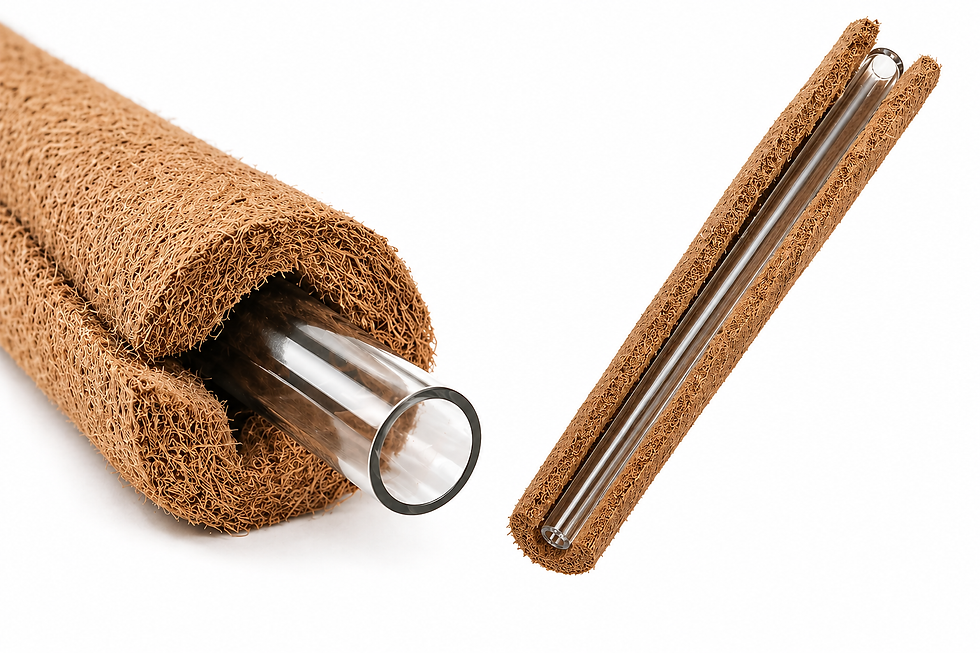
Coir erosion blankets arrive in rolls — standard widths of 1m, 2m, or 2.4m, lengths of 25m or 50m. The blanket unrolls down the slope, pins into the soil surface with staples or stakes, and conforms to the terrain immediately. Rills, channels, and uneven contours are covered without gaps — unlike rigid synthetic sheets that bridge over depressions and create undercut erosion points.
PP netting on one or both sides of the blanket adds tensile strength for steep gradients and high-flow zones. The coir fibre is the erosion-control medium; the netting is the structural reinforcement. GSM ranges from 400 to 900 g/m² depending on slope severity, rainfall intensity, and soil type.
Months 1–6: How Coir Promotes Vegetation
This is where coir outperforms every synthetic alternative. The fibre matrix retains moisture at the soil surface, creating ideal germination conditions for seed applied before or after blanket installation. As the coir absorbs and releases rainwater, it keeps the seed zone consistently damp without waterlogging. Straw blankets do the same but degrade in 6–12 months — often before vegetation is fully established. Synthetic geotextiles don’t retain moisture at all; they shed water and rely entirely on the soil beneath to support germination.

Years 2–5: Controlled Degradation
Coir’s high lignin content (41–45% of fibre mass) is what makes it degrade slowly and predictably. Unlike straw or jute, which can collapse within a single wet season, coir fibre maintains its physical structure for 2–5 years depending on GSM, climate, and soil chemistry. By the time the blanket fully degrades, the root systems of established vegetation have taken over the erosion-control function permanently. The degraded coir becomes organic matter — soil amendment, not waste.
Synthetic geotextiles, by contrast, don’t degrade. A PP geotextile installed in 2026 will still be in the ground in 2076. If it’s ever excavated, it comes out as plastic waste. If it’s left in place, UV exposure and mechanical stress gradually fragment it into microplastic particles that migrate through the soil profile.
➤ Specifying erosion control for a project?
Send us slope gradient, length, and soil type — we’ll recommend the right GSM and netting configuration.
WhatsApp: +91 95662 94433 | Email: hello@adhiannamcoir.com
Product page: Coir Erosion Control
Where Each Material Wins
Coir blankets win on: vegetated slopes where long-term erosion control comes from established root systems; environmentally sensitive sites (waterways, wetlands, parks) where microplastic contamination is prohibited; projects with revegetation as a primary objective; and any site where the material must eventually disappear.
Woven coir geotextiles win on: sub-grade separation beneath roads and railways on soft ground; drainage wraps and filter layers in retaining walls and French drains; coastal and riverbank bioengineering where the woven fabric needs to handle lateral water flow while filtering soil particles.
Synthetic geotextiles still win on: permanent structural reinforcement where the material must last 20+ years without degradation; heavily loaded civil works (retaining walls, foundations, landfill caps) where long-term tensile performance is the primary requirement. If the material needs to last forever, synthetic is the right choice. If it needs to do its job and disappear, coir is.
Trade-Offs
Coir costs more per square metre. Commodity PP geotextiles are cheaper per roll. But disposal and remediation costs for synthetic materials are climbing — and for environmentally sensitive projects, the specification may require biodegradable materials regardless of unit cost.
Not permanent. If you need a geotextile that functions for 20+ years without replacement, coir is not the right material. Its controlled degradation is a feature for revegetation projects and a limitation for permanent structural applications.
PP netting component. Our erosion blankets include polypropylene netting for tensile reinforcement. This means the blanket is not 100% biodegradable — the coir degrades, but the PP net persists. For projects requiring fully biodegradable solutions, we can discuss alternatives. Transparency matters: we state the material composition upfront.
➤ Get Project-Specific Pricing on Erosion Control
Erosion control blankets (400–900 GSM, PP net reinforced) and woven coir geotextiles (open and closed weave). Custom widths and lengths. ISO 9001 & ISO 14001 certified. 4–6 week lead time.
Request a Quote:
WhatsApp: +91 95662 94433
Email: hello@adhiannamcoir.com
Product Page: Coir Erosion Control
Contact: Get in Touch

Comments