.png)

Coir Wastewater Filter Media: A Natural Fibre Alternative for India’s Treatment Plants


India has a wastewater problem that most people never see. Every day, the country’s cities generate around 72,368 million litres of sewage — and only about 28% of it actually gets treated. The rest flows, largely untreated, into rivers, lakes, and farmland. What makes this harder is that the gap is widening: between 2022 and 2024, treatment capacity grew slower than the sewage being produced[2]. As new treatment plants come online to close that gap, one quiet decision repeats itself at every site: what filter media goes inside. This is where coir wastewater filter media — a filtration medium made from coconut husk fibre — has started to earn a place alongside the synthetic plastics that have dominated for decades. Let’s look at how it works, where it fits, and where it doesn’t.
CPCB, “National Inventory of Sewage Treatment Plants.” Urban India generates ~72,368 MLD sewage; only ~28% (20,235 MLD) treated. Down To Earth summary
Between Aug 2022 and Jun 2024, treatment capacity grew 545 MLD while generation rose 788 MLD — the gap is widening. Sustainability Shiksha / CPCB
What is coir wastewater filter media?
Coir wastewater filter media is a filtration medium made from natural coconut coir fibre, engineered into pads, rolls, cartridges, or loose random-pack modules. It captures suspended solids from sewage and effluent — typically 94% of particles at 60 microns — and is used as a natural replacement for synthetic polypropylene (PP) and polyethylene (PE) media in treatment systems.
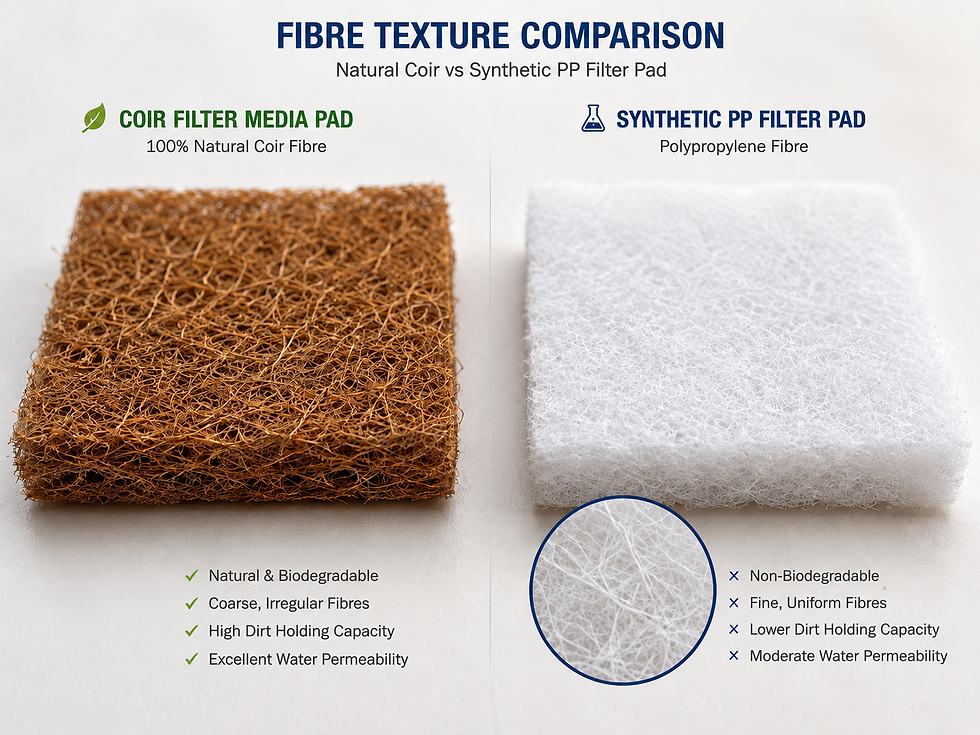
To understand why coir works as a filter, it helps to picture the fibre itself. Coconut coir is coarse, springy, and irregular — nothing like the smooth, uniform strands of synthetic media. When you pack it into a filtration bed, those irregular fibres create a dense, tangled maze of channels. Water passes through, but suspended solids collide with the fibre surfaces and get held. The rougher and more tortuous the path, the more the media captures. This is the same principle behind every fibrous filter; coir simply achieves it with a plant by-product instead of a petrochemical.
How does coir compare to synthetic PP and PE media?
Coir media generally holds more solids before it needs changing, because its open fibre network resists the rapid binding that clogs synthetic media under high-TSS (total suspended solids) streams. It also sheds no microplastics and biodegrades at end of life. Synthetic PP and PE media, by contrast, offer tighter tolerances and unlimited service life — but persist as plastic waste and shed microplastic fragments into the treated stream.
For an operator, the practical difference shows up in two places: change-out frequency and disposal. Coir’s higher solids-holding capacity[1] means fewer interruptions to swap saturated media — which matters in Indian plants where downtime and manual handling are real operating costs. On disposal, spent coir is organic matter, not plastic. It doesn’t need the separate waste stream that synthetic media eventually demands. The trade-off is honest, though: synthetic media can be engineered to finer, more consistent micron ratings, and it lasts far longer per unit. Coir is a natural material with natural variability, and it is designed to be replaced and composted, not to last forever.
Where does coir filter media fit in a treatment system?
Coir filter media works best in primary and secondary solids capture — septic biofilters, package treatment plants, municipal pre-filtration, industrial effluent screening, trickling filters, and aquaculture systems. It suits decentralised and small-to-mid-scale plants especially well, where its higher solids loading and simple change-out reduce operating burden.
India’s treatment challenge isn’t only about giant municipal plants. A large share of new capacity is coming from decentralised and package sewage treatment plants — the compact units mandated for apartment complexes, commercial buildings, and institutions that generate more than a threshold volume of effluent. Under the 2026 CPCB norms, these units must hit stricter reuse-grade targets, with BOD below 10 mg/L. Coir media serves the solids-capture stage of these systems in several formats:
• Package & decentralised plants — filtration pads for septic biofilters serving residential and commercial buildings.
• Municipal pre-filtration — primary sediment removal ahead of biological treatment stages.
• Industrial effluent — solids capture for food processing, textile, and manufacturing discharge — relevant across Tamil Nadu’s textile belt around Tiruppur and Coimbatore.
• Trickling filters — random-pack coir media as a natural substitute for plastic bio-media in fixed-film systems.
• Aquaculture — suspended solids and organic matter filtration in recirculating fish farm systems.
➤ Evaluating filter media for a treatment plant?Send us your influent TSS, flow rate, and current media type. We’ll recommend a coir grade and can supply pilot samples for a side-by-side trial.WhatsApp: +91 95662 94433 | Email: hello@adhiannamcoir.comProduct page: Coir Filtration Media
What are the limits of coir filter media?
Coir is not a drop-in for every application. It cannot match the fine, consistent micron ratings of engineered synthetic media, it biodegrades and must be replaced periodically, and its natural variability means density is tuned per site through pilot testing rather than guaranteed off a spec sheet. For final polishing to reuse-grade clarity, coir typically works upstream of a finer stage, not as the last barrier.
Being straight about this matters more than a sales pitch. Coir’s micron range runs roughly 16–82 microns depending on media thickness and density[1] — excellent for solids capture, but not a substitute for membrane or fine cartridge filtration where sub-micron clarity is the requirement. And because coir is a natural fibre, the right density for your site depends on your actual influent. That’s why we tune media through pilot KPIs rather than shipping a single universal grade. If your plant needs a filter that runs untouched for a decade, synthetic still wins. If it needs strong solids capture, easy handling, and a compostable end of life, coir is worth trialling.
Frequently Asked Questions
Is coir filter media approved for use in Indian STPs?
Coir filter media is used as a solids-capture medium within treatment systems that must meet CPCB effluent standards; the media itself is a component, and compliance is measured on the plant’s final effluent quality. Because coir handles the solids-removal stage rather than final discharge testing, it is specified as part of a treatment train designed to meet the 2026 CPCB norms. We provide material composition data for approval processes.
How often does coir filter media need replacing?
Replacement frequency depends on influent solids load, flow rate, and media density, so there is no single figure. Coir’s advantage is that its open fibre network holds more solids before saturation than synthetic media of similar dimensions, which extends the interval between change-outs. The practical schedule is best set during a pilot run on your actual effluent stream.
What happens to spent coir filter media?
Spent coir media is organic coconut fibre, so it biodegrades and can be composted rather than sent to landfill or a plastic-waste stream. This is a meaningful operating difference from synthetic PP and PE media, which persist indefinitely and shed microplastic fragments. The captured sludge is handled separately per your plant’s existing sludge-management process.
Can coir media handle high-TSS industrial effluent?
Yes — coir is well suited to high-TSS streams because its open structure resists the rapid binding that clogs tighter synthetic media. This makes it a fit for food processing, textile, and manufacturing discharge, which are common across Tamil Nadu’s industrial clusters. Media thickness and density are tuned to the specific solids load.
What formats does coir filter media come in?
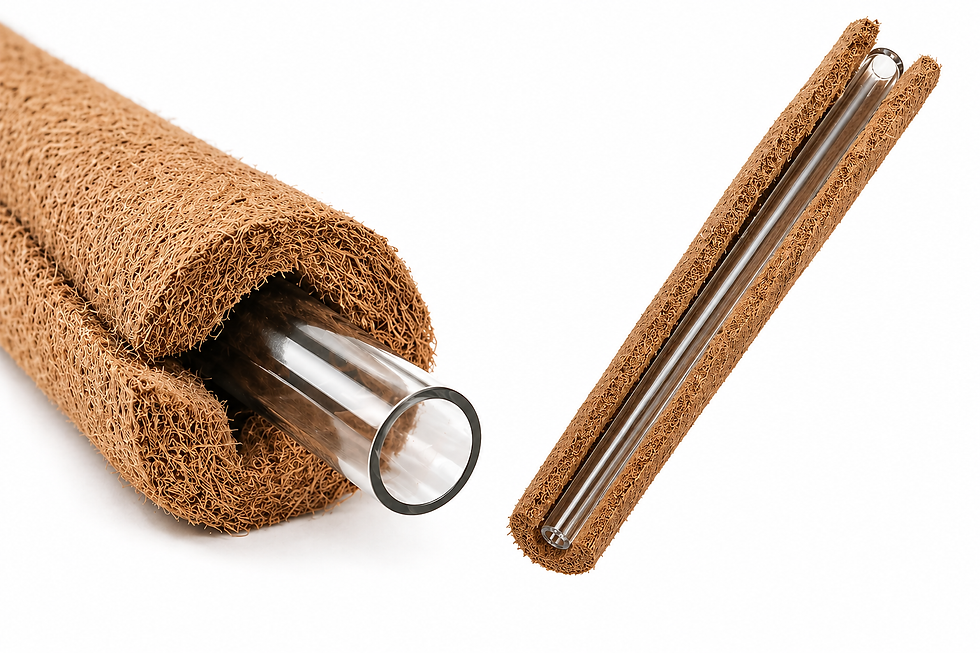
Coir filter media is available as high-density pads, retrofit rolls, cartridge inserts, packed media modules, and random-pack media for trickling filters. GSM ranges from 700 to 2,200 g/m² and thickness from 5 mm to 100 mm, so the format can be matched to existing housings or specified for a new build.
Where is this coir filter media manufactured?
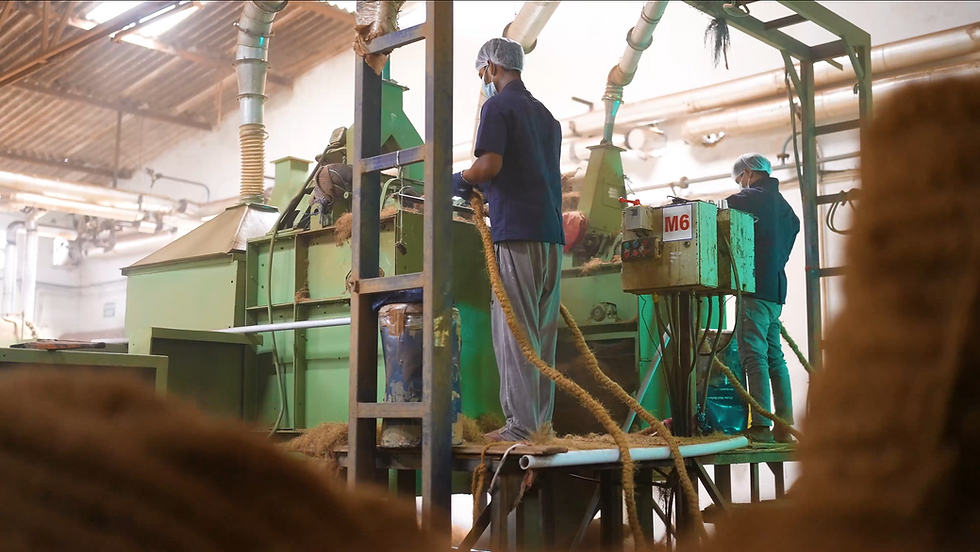
It is manufactured at the Adhi Annam Coir Comforts facility in Pollachi, Coimbatore district, Tamil Nadu — one of India’s primary coconut-growing regions. The plant runs an in-house quality lab and produces 80–90 MT of filtration media per month under ISO 9001:2015 and ISO 14001:2015 certification.
➤ Request Pilot Samples or Media SpecificationsWe supply coir filtration media as pads, rolls, cartridges, and random-pack modules, tuned to your site’s influent through pilot KPIs. 80–90 MT/month capacity. ISO 9001 & ISO 14001 certified. 4–6 week lead time.
Get in touch:WhatsApp: +91 95662 94433
Email: hello@adhiannamcoir.com
Product Page: Coir Filtration Media
Contact: Talk to Our Team

Comments