.png)

Coir Seedling Trays and Root Trainers: How to Boost Transplant Survival in Commercial Reforestation


When a reforestation programme plants 100,000 seedlings and 15–20% die within the first year, nobody blames the species selection or the site prep. They blame transplant shock. The seedling’s roots were circling inside a plastic tray, got ripped during extraction, and never recovered. Coir seedling trays and root trainers solve this at the root — literally. The seedling goes into the ground still inside its container. The coir wall biodegrades. The roots grow straight through. Transplant shock drops to near zero, and the survival rate changes the economics of the entire programme.
The Transplant Problem at Scale
In plastic plug trays, roots hit smooth walls and spiral. By the time the seedling is ready for field planting, those circling roots are lignified — permanent deformities that restrict water uptake and anchor strength for the life of the tree. Nursery workers pop seedlings out of trays, tearing fine feeder roots in the process. The seedling arrives in the ground stressed, root-damaged, and vulnerable to drought during the critical first dry season.
At small scale, you can hand-tease each root ball. At 50,000 or 500,000 seedlings, that’s not an option. The container itself has to produce the right root architecture from the start.
How Coir Root Trainers and Seedling Trays Fix It
Two products, one principle: the pot goes into the ground with the plant.
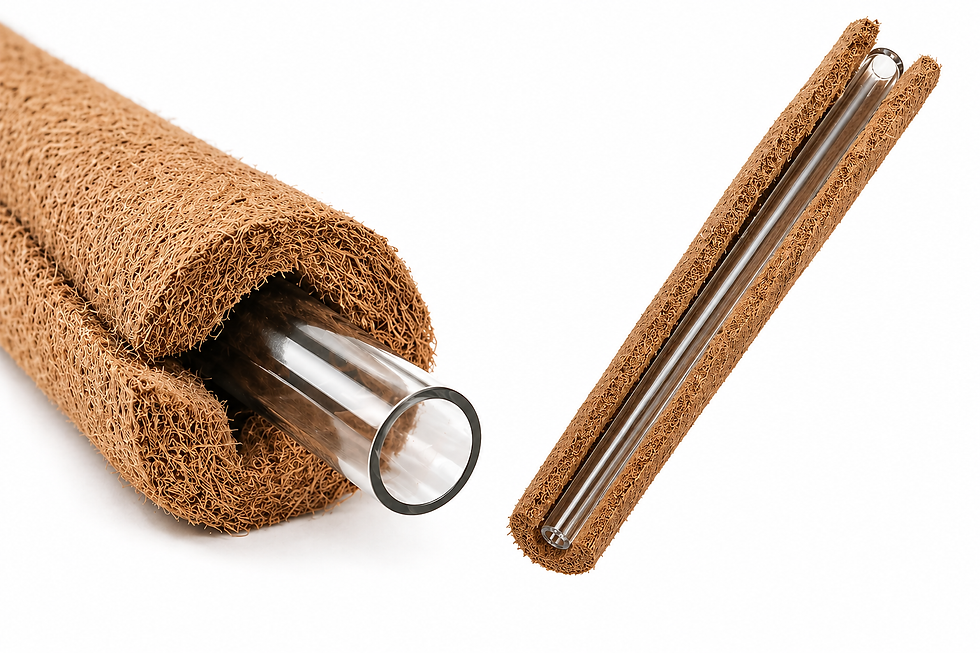
Coir root trainers are tapered pots with open bases. The taper guides roots downward. When a root tip reaches the open base or the porous coir wall, it contacts air and dehydrates — this is air pruning. The plant responds by pushing out new lateral roots further up, creating a dense, fibrous root system instead of a few long circling ones. Research shows air-pruned seedlings produce 20–25% greater top growth than those from standard plastic containers. Available in 60ml, 150ml, and 300ml.
Coir seedling trays are multi-cell trays where each cell is plantable. Cut the cells apart with a knife, plant the entire section into the ground. Roots grow through the coir wall as it biodegrades over weeks. No extraction, no root tearing, no transplant shock. Custom cell configurations — count, depth, and tray dimensions — are available to match your propagation system.

Who’s Ordering These — and at What Scale
Government reforestation programmes. Forest departments and environmental agencies planting 50,000–1,000,000+ seedlings per season. Coir trainers eliminate the cost of tray collection, washing, and return logistics that plastic trays require.
Agroforestry nurseries. Sapling production for coffee, cocoa, rubber, oil palm, and spice plantations. Root trainer sizes (60–300ml) match the seedling stages for these crops.
NGO and carbon-offset planting. Organisations running tree-planting programmes with ESG or carbon credit documentation. Natural-fibre, zero-plastic propagation adds credibility to the reporting.
Commercial nurseries. Wholesale vegetable, flower, and ornamental seedling production for garden centres and landscaping contractors.
Home garden and DTC brands. Seed-starting kits with natural fibre trays for subscription boxes and e-commerce retail. The eco aesthetic sells itself at point of purchase.
➤ Running a nursery or planting programme?
Request samples of root trainers (60ml, 150ml, 300ml) and custom-cell seedling trays. We respond within 24 hours.
WhatsApp: +91 95662 94433 | Email: hello@adhiannamcoir.com
Product page: Coir Horticulture Products
Specs That Matter for Procurement
Root trainer sizes: 60ml (small seedlings, herbs), 150ml (tree saplings, vegetables), 300ml (larger forestry stock). Tapered shape with open drainage base for air pruning.
Seedling tray configurations: Custom cell count, cell depth, and overall tray dimensions. Both rubberised coir and needle felt construction available.
Material: Rubberised coconut coir fibre. Biodegrades in soil over 8–16 weeks depending on moisture and soil conditions.
Certifications: ISO 9001:2015, ISO 14001:2015.
Lead time and MOQ: 4–6 weeks. MOQ depends on configuration — contact us for specifics. We supply container-load volumes for government and NGO programmes.
Trade-Offs
Higher unit cost than plastic trays. Plastic plug trays cost less per cell. But plastic trays need collection, washing, sterilisation, and return shipping after each cycle. Coir trays are single-use by design — they go into the ground. When you factor in reverse logistics, the cost gap narrows or disappears.
Moisture management differs. Coir walls are porous — they dry faster at the edges than plastic. Adjust irrigation frequency or use drip systems to keep cells evenly moist, especially in low-humidity greenhouses.
Not reusable. That’s the point — they’re designed to biodegrade. If your operation requires trays you can wash and restack for 5+ seasons, plastic or rigid containers are the better fit. If your operation plants 50,000 seedlings and doesn’t want 50,000 plastic trays coming back, coir is the answer.
➤ Get Wholesale Pricing for Your Planting Season
Root trainers: 60ml, 150ml, 300ml. Seedling trays: custom cell count and dimensions. ISO certified. 4–6 week lead time. Container-load supply for large programmes.
Request a Quote or Samples:
WhatsApp: +91 95662 94433
Email: hello@adhiannamcoir.com
Product Page: Coir Horticulture Products
Contact: Get in Touch

Comments