.png)

Natural Paint Booth Filters: How Coir Media Captures Overspray and Cuts Disposal Costs


The filter pad in your paint booth costs a few dollars. Disposing of it can cost ten times that. Spent fibreglass and polyester paint booth filters saturated with certain coatings can be classified as hazardous waste under RCRA — requiring manifested pickup, licensed hauling, and documented disposal. Switch to a natural paint booth filter made from coconut coir, and that classification changes. Spent coir filters are non-hazardous industrial waste. Same overspray capture. Fraction of the disposal cost. That’s the calculation most facility managers haven’t made yet.
The Disposal Problem Nobody Budgets For
Paint booth operators change filters frequently — some lines swap pads weekly, others daily on high-volume runs. The purchase price per pad is low enough that nobody questions it. But disposal cost per pad is where the real expense hides. Synthetic filter media saturated with solvent-based or isocyanate coatings can trigger hazardous waste classification, which means you can’t just bin them. You need a licensed waste hauler, a manifest, and a paper trail. Even where the filters don’t cross the hazardous threshold, landfill charges for industrial waste have been climbing 5–10% annually in most U.S. and EU markets. Coir filter pads sidestep this entirely: the base material is natural coconut fibre, and spent pads classify as non-hazardous industrial waste. In some jurisdictions, they qualify for biomass energy recovery — meaning the waste handler pays you.
How Coir Captures Overspray
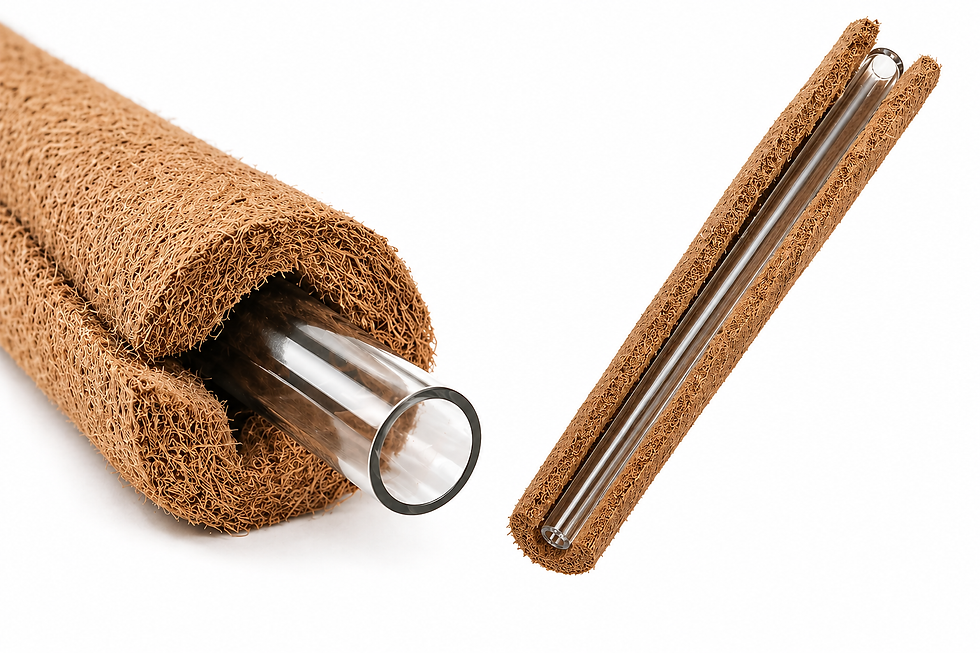
The mechanics are straightforward. Coir filter pads use a dense, open-fibre network that lets air pass through while trapping paint particles on the fibre surfaces. The fibrous matrix creates a tortuous path that forces overspray particles to collide with and adhere to the coir. As the pad loads up, it actually becomes more efficient — trapped particles narrow the air gaps, catching smaller particles that would have passed through a clean pad.
Our coir filter media is rated G1–G4 pre-filter class, with GSM ranging from 700 to 2,200 g/m² and thickness from 5 mm to 100 mm. Standard pad size is 500 × 500 mm in 30, 40, and 50 mm thicknesses. Rolls at 1,000 × 2,000 mm are available for larger booth housings. Density is tuneable to your airflow and capture requirements — heavier GSM means higher solids loading capacity before change-out.

What Changes When You Switch From Fibreglass
Disposal classification drops. Non-hazardous vs. potentially hazardous. This alone can cut your waste management cost per filter change by 50–70%, depending on your coating chemistry and local regulations.
Higher solids loading. Coir’s fibre structure holds more paint solids per square metre before reaching pressure-drop limits than standard fibreglass pads. Fewer change-outs per shift means less downtime and lower pad consumption.
Zero microplastic shedding. Fibreglass and polyester filters shed synthetic particles into the exhaust airstream. Coir sheds natural fibre — zero microplastics downstream of the booth.
No skin or respiratory irritation. Fibreglass filters require gloves and masks during handling and change-out. Coir pads are handled bare-handed with no PPE requirements. For facilities doing multiple filter swaps per day, that’s meaningful labour savings.
Chemical and flame resistance. Coir is naturally resistant to solvents, water, and heat. It won’t melt or release toxic fumes if exposed to radiant heat near the spray line.
➤ Want to test coir media in your spray booth?Send us your booth housing dimensions, airflow specs, and coating type — we’ll recommend the right pad format and density.WhatsApp: +91 95662 94433 | Email: hello@adhiannamcoir.comProduct page: Coir Filtration Products
Who’s Already Using Coir Paint Booth Filters
Auto body shops. Exhaust-side overspray capture for car refinishing. High change-out frequency makes disposal cost savings compound fast.
Furniture manufacturers. Lacquer and stain booths running 8–12 hours daily. Coir’s higher loading capacity means fewer stops to swap pads mid-shift.
Industrial OEMs. Metal coating lines for appliances, machinery, and equipment housings. Facilities with ESG reporting obligations benefit from documenting non-hazardous, natural-fibre waste streams.
Aerospace and defence. Speciality coating booths where chemical resistance and documented waste classification are procurement requirements, not preferences.
What Coir Filters Won’t Do
Not a HEPA replacement. Coir is a G1–G4 pre-filter. It captures overspray and coarse particulates. It does not replace HEPA or bag filters for fine particle capture downstream.
Disposal classification depends on coating. The coir itself is non-hazardous. But if saturated with a coating that’s classified hazardous under RCRA or equivalent local regulation, the spent filter assembly may still need hazardous handling. Always check with your waste hauler based on your specific coating chemistry.
Manufactured to order. 4–6 week lead time. If you run out of pads mid-week, you can’t grab coir off a shelf yet. Plan your filter inventory accordingly — our monthly filtration capacity is 80–90 MT, so volume supply isn’t the bottleneck. Planning is.
➤ Request Bench-Test Samples
We’ll send pads matched to your booth housing for a side-by-side trial against your current filters. No commitment, no charge for the first sample set.
Request Samples:
WhatsApp: +91 95662 94433
Email: hello@adhiannamcoir.com
Product Page: Coir Filtration Products
Contact: Get in Touch
Related Reading
US EPA: Spent synthetic filter media from paint operations may be classified as hazardous waste under RCRA if saturated with certain coatings. EPA Hazardous Waste
Manufacturer data: Adhi Annam Coir Comforts Pvt. Ltd. Product catalog v3. Monthly filtration capacity: 80–90 MT. ISO 9001:2015, ISO 14001:2015.
ASHRAE pre-filter classifications G1–G4 (coarse filtration). Equivalent to ISO 16890 ePM10 and MERV 1–8 ranges.

Comments