.png)

Coir vs. EPS Foam: Why Electronics and Cosmetics Brands Are Replacing Styrofoam Inserts


“Can we swap out our Styrofoam inserts without redesigning the whole box?” That’s the first question every packaging manager asks when they hear about coir foam inserts as an EPS foam alternative. The short answer: yes. The longer answer involves EPR fees, prototype timelines, and what happens to your packaging costs when seven U.S. states and the entire EU start charging producers for plastic packaging disposal. Here are the questions we get asked most — answered with specs, not marketing.
“Will it protect my product as well as EPS?”
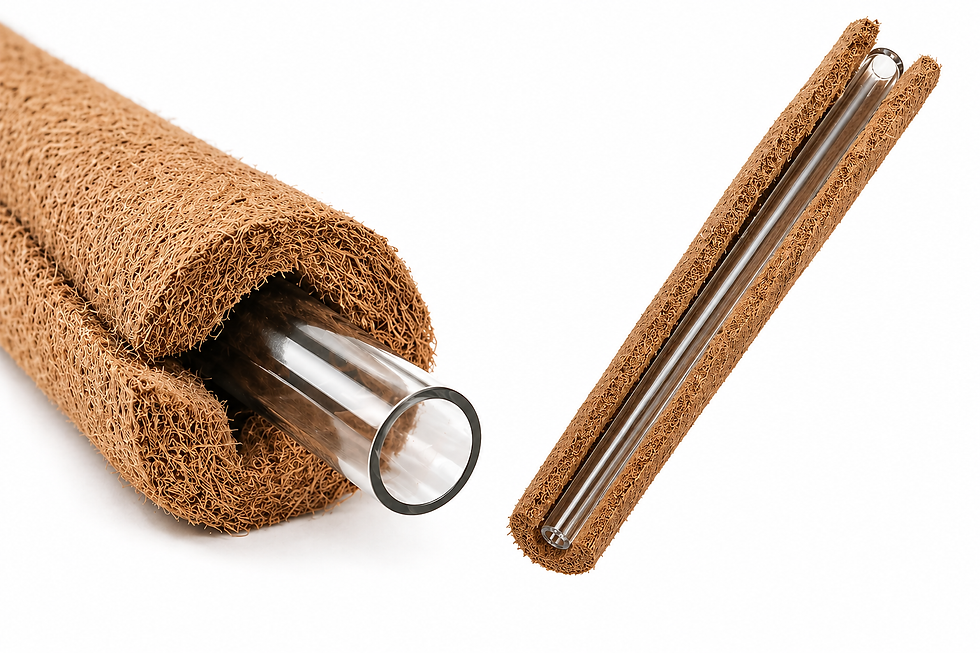
Coir foam inserts are precision-moulded using CNC aluminium moulds cut to your exact product dimensions. The insert cradles your product with the same snug fit as EPS. The cushioning mechanism is different — coir absorbs impact through fibre compression rather than cellular fracture — but the result is equivalent protection for electronics, glassware, ceramics, cosmetics, and medical devices. We match your existing carton dimensions so there’s no box redesign needed.
“How fast can I get a prototype?”
14–21 days from CAD file or product measurements to a physical coir sample in your hands. Send us your product dimensions — or ship us the product itself — and we design the insert, cut the mould, and send a sample. If the fit needs adjustment, we iterate within days. Production runs follow on a 4–6 week lead time.

“What about EPR fees on plastic packaging?”
This is the question driving the switch. Seven U.S. states have enacted EPR packaging laws that make producers pay for disposal of their packaging. Oregon’s fees started in 2025. Colorado’s invoices began January 2026. The EU’s PPWR requires all packaging to be recyclable or compostable by 2030. EPS foam fails both tests in most jurisdictions. Coir inserts are biodegradable, compostable, and exempt from EPR fees everywhere these laws exist.
“Does it look cheap?”
The opposite. Coir’s natural fibre texture reads as premium, not budget. Cosmetics and electronics brands using coir inserts report that unboxing experience improves — customers associate natural materials with quality and environmental responsibility. If your brand runs sustainability messaging, your packaging now backs it up instead of contradicting it.
➤ Send us your product dimensions — we’ll design the insert
Packaging audit, prototype, and quote within 3 weeks.
WhatsApp: +91 95662 94433 | Email: hello@adhiannamcoir.com
Product page: Coir Foam Cushioning
“What can’t coir replace?”
Cold-chain thermal insulation. EPS is an excellent thermal insulator for temperature-controlled shipping. Coir cushions and protects, but doesn’t maintain temperature like closed-cell foam. For cold-chain, coir isn’t the right thermal layer.
Ultra-lightweight void fill. For filling large empty spaces where protection isn’t the priority, EPS peanuts or air pillows weigh almost nothing. Coir foam blocks do the same job but weigh more. For weight-sensitive air freight, calculate the trade-off.
Direct water submersion. Coir is natural fibre. Prolonged submersion softens it. For shipments exposed to standing water (not humidity — humidity is fine), use a poly liner inside the carton.
Commodity price matching. Virgin EPS is cheap because petrochemical feedstock is subsidised. Per-unit, coir costs more. But once EPR fees, plastic taxes, and disposal charges land on the EPS side, total cost often favours coir — especially into the EU and California.
➤ Explore Our Full Packaging Range
Coir foam inserts, foam blocks, bubble wrap, corner caps, pallets, crates, table protectors, tube protectors, and packaging containers. ISO 9001 & ISO 14001 certified. 14–21 day prototyping. 4–6 week production.
Request a Quote:
WhatsApp: +91 95662 94433
Email: hello@adhiannamcoir.com
Product Page: Coir Packaging Solutions
Contact: Get in Touch

Comments